I missed getting my hands dirty.
Years ago, I ordered a new processor for my laptop but couldn't afford the installation fee. So I did what any broke, curious kid would do—I dismantled the entire thing myself. Screws everywhere, thermal paste on my fingers, no idea if I'd ever put it back together. But when I powered it on and it actually worked, something clicked. That was the moment I realized how much I loved working with technology—not just using it, but understanding it at the deepest level.
These days, I spend most of my time in the clouds—strategizing, managing, and looking at the big picture. But I'm still an engineer at my core. I missed that electric feeling of compiling code late at night, the specific joy of making a machine do something it wasn't supposed to do.
The Challenge
The AI discourse had become saturated with "Top 10 Ways to Use ChatGPT." I didn't want to read another article about prompt engineering. I didn't want to just use an API—I wanted to own the weights. I wanted to take this massive, world-changing technology and deconstruct it until I understood every bolt and gear.
So I decided to embark on a 30-day sprint: build a conversational Large Language Model from scratch, from raw data ingestion to the final probability distribution.
The Solution
I architected a hybrid approach: build the "data factory" locally on my RTX 3080, then rent the absolute minimum compute needed to train—a single NVIDIA A100 instance on Google Colab.
The math hits you immediately when you're limited to 80GB of VRAM. I designed a model roughly equivalent to GPT-2 Small: 12 transformer layers, 12 attention heads, and an embedding dimension of 768. This forced strict engineering discipline. I couldn't just throw a massive batch size at the problem. I had to become intimate with memory management, utilizing gradient accumulation to simulate larger batch sizes without blowing out the memory.
This wasn't a 9-to-5 project. It became my second shift—working my day job, having dinner with my family, then starting the real work around 9 PM. I'd be tweaking hyperparameters and debugging CUDA errors well past midnight, only to drag myself out of bed at 5 AM to check training logs.
Technical Architecture
I didn't want to just download a generic corpus like the Pile or C4—I wanted to understand the data engineering pipeline from scratch. So I built a synthetic data factory locally on my RTX 3080 using LangChain.
The goal was to generate 100,000+ unique, high-quality customer service conversations. I engineered "agents" to ensure diversity in tone, topic, and complexity. The model needed to learn the universal patterns of helpfulness and de-escalation, whether the issue was a billing error or a technical glitch.
- Data Generation: Custom LangChain pipeline producing synthetic customer service dialogues
- Model Architecture: GPT-2 Small equivalent with 12 transformer layers, 768 dimensions, 12 attention heads
- Training Compute: Single NVIDIA A100 (80GB VRAM) on Google Colab
- Context Length: 1024 tokens
- Tokenization: Hugging Face tokenizers for efficient text processing
- Backend API: Flask REST API with CORS support and streaming SSE
- Frontend: React with TypeScript for interactive chat interface
- Deployment: Docker containers for both CPU and GPU inference
The model implements key features including:
- Multi-head self-attention for capturing contextual relationships
- Positional encodings for sequence order information
- Layer normalization and dropout for stable training
- Configurable generation with temperature, top-k, top-p sampling, and repetition penalties
Data and Training
Training a model is a lesson in patience and observability. When you launch a run that takes days, you become obsessed with the loss curve. In the beginning, loss drops rapidly as the model learns basic syntax. But then the real battle begins.
I first noticed real improvement in responses at about 60,000 samples. But the engineer in me wouldn't let it go—I was determined to get to 100,000 samples to see if more data would equal better performance or hit diminishing returns.
There were plenty of hopeless moments. I watched a 14-hour run suddenly spike in loss—a sign that my learning rate was too high. I woke up to disconnected runtime errors after overnight runs, or weights failing to save because of Google Drive timeouts.
- Dataset: 100,000+ synthetic customer service conversations
- Parameters: ~85 million trainable parameters
- Training: Custom loop with gradient accumulation and learning rate scheduling
- Optimization: AdamW optimizer with weight decay
- Generation: Streaming inference with nucleus sampling, top-k filtering, and repetition penalties
Impact
After weeks of tweaking, cleaning, and restarting, the training finally finished. I loaded the weights, fired up the inference script, and typed: "Hello! I need help with my bill."
The cursor blinked. And then:
"Hi there ! I ' m happy to help . Could you tell me what part of the bill looks off ?"
It wasn't Shakespeare. It wasn't GPT-4. But it was a reasonable thought, generated by a system I had built, trained on data I had curated. It was the only thing I wanted to talk about for the rest of the day.
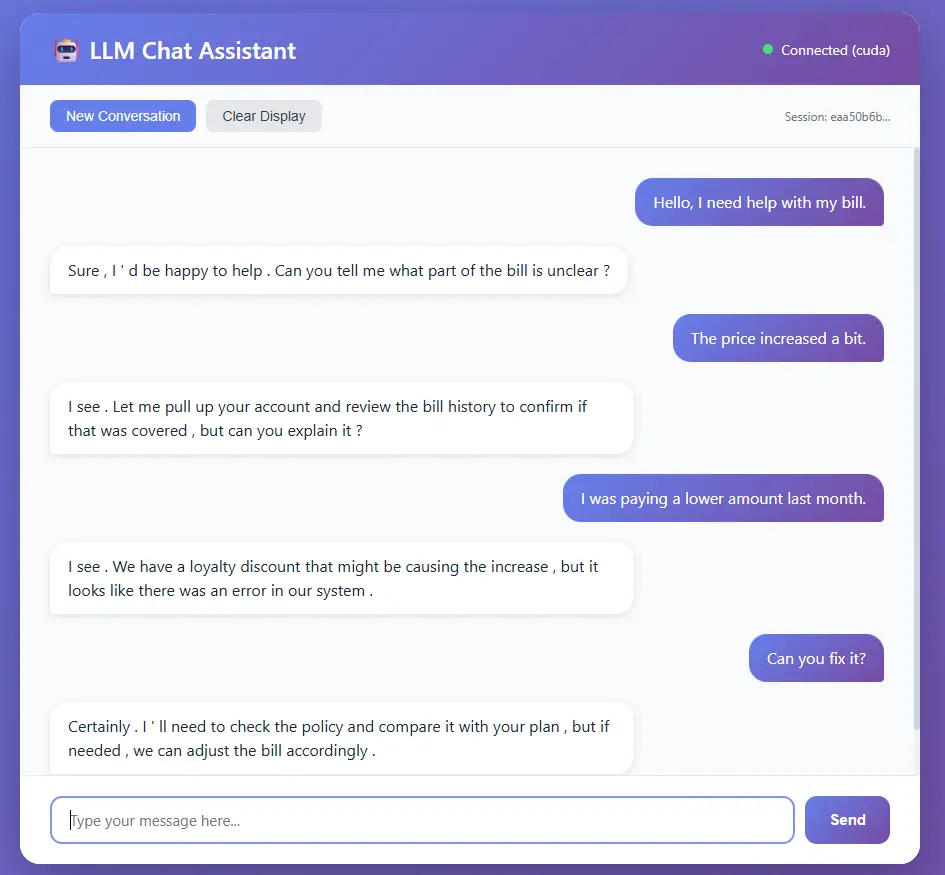 A multi-turn conversation with the custom LLM, handling a billing inquiry from start to resolution.
What I Took Away
I'm no expert—not even close. But I now have practical experience that no amount of reading could give me. When I look at AI-powered workflows, I'm not just seeing magic anymore. I can start to understand what's happening under the hood, where the limitations might be, and what questions to ask.
More than anything, this project reminded me why I got into technology in the first place. Not to use tools, but to understand them. Not to follow tutorials, but to break things and figure out why. The technology moves fast, but the fundamentals—constraints, data integrity, and iterative problem solving—haven't changed at all.
If you're curious about AI and find yourself just skimming headlines or tweaking prompts, I'd encourage you to go deeper. You don't need a cluster of GPUs or a PhD. You just need curiosity, a willingness to fail, and enough stubbornness to keep going when a 14-hour training run crashes at 3 AM.
And if you want to try breaking my new toy—go for it. Luckily, this was just a pet project. Give the demo a spin and see what you can get it to say.